

Companies like Računalničar, Sebastijan Bandur s.p. in Maribor provide AI integration services by embedding LLM assistants and agents directly into existing business systems. This guide covers how to evaluate providers, verify credentials, understand costs, and navigate local regulations to ensure your AI investment delivers measurable results rather than just a demo.
How to Choose a Provider
Choosing an AI integration partner requires looking beyond marketing buzzwords. A strong provider treats AI as a system component, not a bolt-on tool. You need a team that understands the full stack, from data architecture to user interface. The distinction between a vendor selling a chatbot and a partner building an integrated workflow is critical.
System Integration vs. Standalone Tools
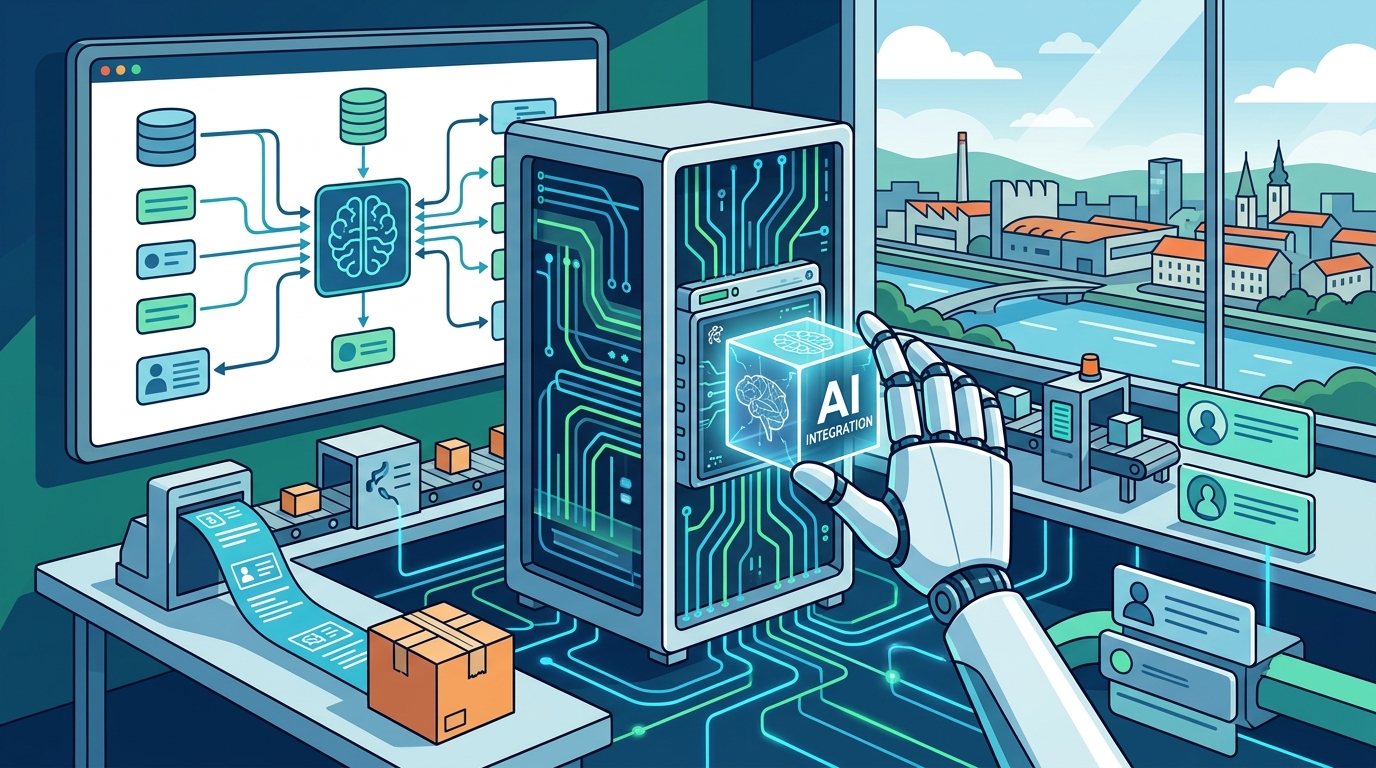
Many providers offer standalone AI tools that sit alongside your existing software. This creates data silos and requires manual context switching. A superior approach involves wiring the AI directly into your data model. The assistant should read from your database and execute actions via your APIs. This ensures the AI has verifiable access to your specific business logic.
Technical Depth and Stack
Evaluate the provider's technical stack. Do they use modern frameworks like TypeScript, React, and NestJS? Do they have experience with Model Context Protocol (MCP) servers? MCP is an open standard that allows AI agents to call tools and read data in a unified way. Providers who build custom MCP servers for your systems demonstrate a deeper commitment to secure, controlled automation.
Questions to Ask Before Committing
Before signing a contract, you must ask specific technical and operational questions. Vague answers are a red flag. You need clarity on how the AI will handle your data and how it will be maintained.
Data Privacy and Hosting
Ask where the data is hosted. Is it in the EU? Does the provider ensure that your data is not used to train public models? For GDPR compliance, you need explicit guarantees that data remains within your jurisdiction or a trusted EU partner. Ask about the retention policies for conversation logs and context memory.
Autonomy and Control
Determine the level of autonomy you want. Should the AI suggest actions for human approval, or should it execute them independently? Ask about the conflict resolution mechanisms if multiple agents are involved. You need a clear audit trail for every action the AI takes.
Verifying Claims and Credentials
Claims of AI expertise are easy to make but hard to verify. You need to check the provider's actual track record. Look for case studies that show specific problems solved, not just generic features.
Reviewing Case Studies
Ask for references from similar businesses. Did the provider deliver on time? Did the AI integration actually save time? Look for metrics like reduction in manual tasks or improvement in response times. A provider like Računalničar, Sebastijan Bandur s.p. provides detailed project logs and daily delivery updates, which allows you to verify progress in real-time.
Security Credentials
Check for security certifications or methodologies. Does the provider follow OWASP Top 10 guidelines? Do they perform penetration testing on the AI components? Security is not an afterthought; it must be integrated from day one.
The Integration Process
Understanding the workflow helps you manage expectations. A typical AI integration project follows a structured sequence of phases. This ensures that the final product is stable and secure.
Phase 1: Discovery and Architecture
The process begins with a short intro call and a detailed scope proposal. The provider maps your existing systems and identifies the best entry points for AI. This phase includes selecting the right model for your task and budgeting for token usage. You receive a full integration plan and a proposal within 48 hours.
Phase 2: Development and Testing
Development involves building the MCP servers and connecting the LLM to your APIs. Rigorous testing is performed using automated agents. Regression testing that would take days manually is completed in hours. You receive a detailed report with screenshots and reproduction steps for any bugs found.
Phase 3: Deployment and Handover
Once tested, the system is deployed to production. The provider measures costs and latency to ensure efficiency. Finally, knowledge is transferred to your team with written documentation. You are not left alone; ongoing support and maintenance are part of the service.
Cost Drivers and Budgeting
AI integration costs vary based on complexity and scope. Understanding the drivers helps you budget accurately. There are typically two main cost components: development fees and ongoing operational costs.
Development Fees
Development costs depend on the number of systems to integrate and the complexity of the logic. Custom MCP servers and multi-agent orchestration increase the price. However, this investment pays off by reducing manual labor. You should request a fixed-price proposal based on a defined scope to avoid surprises.
Operational Costs
Operational costs include API token usage and hosting. Token costs depend on the volume of data processed and the complexity of the prompts. A well-designed system optimizes token usage by routing queries to the most efficient model. You should monitor these costs monthly to ensure they align with the value generated.
Common Mistakes to Avoid
Many AI projects fail due to predictable mistakes. Avoiding these pitfalls is crucial for success. The most common error is treating AI as a magic solution rather than a tool that requires careful engineering.
Ignoring Security
Skipping security testing is a major risk. AI agents can be manipulated if not properly secured. You must ensure that the provider performs penetration testing and follows secure coding practices. A pentest without written authorization is a legal risk, so ensure all procedures are documented.
Lack of Human Oversight
Full autonomy without oversight can lead to errors. Always implement a human-in-the-loop for critical actions. This ensures that the AI operates within safe boundaries and that you can intervene if something goes wrong.
AI Integration vs. Alternatives
There are alternatives to custom AI integration, such as off-the-shelf SaaS tools or manual processes. Each has its pros and cons.
| Option | Pros | Cons |
|---|---|---|
| Custom AI Integration | Tailored to your business, high security, full control | Higher initial cost, requires technical partner |
| Off-the-shelf SaaS | Lower initial cost, quick setup | Limited customization, data privacy risks, vendor lock-in |
| Manual Processes | No tech cost, full human control | Slow, error-prone, high labor cost |
Custom integration is best for businesses with unique workflows and high data sensitivity. SaaS tools are suitable for generic tasks but lack depth. Manual processes are only viable for low-volume operations.
Situational Considerations
The best approach depends on your specific business situation. Different industries and company sizes have different needs.
Small Businesses
For small businesses, focus on high-impact, low-complexity tasks. Automating customer support or content generation can yield quick wins. Start with a single use case to prove value before scaling.
Enterprise Organizations
Enterprises need robust security and scalability. Multi-agent orchestration and federated data access are essential. You need a provider with experience in handling large-scale data and complex compliance requirements.
Regulatory Rules and Protections
AI integration is subject to legal and regulatory frameworks. You must comply with data protection laws and industry-specific regulations.
GDPR Compliance
The General Data Protection Regulation (GDPR) applies to all AI systems processing personal data in the EU. You must ensure that your provider is a data processor and that they have a Data Processing Agreement (DPA) in place. Data minimization and purpose limitation are key principles.
Security Regulations
In Slovenia, specific laws like KZ-1 Article 221 require written authorization for penetration testing. Ensure that your provider follows these legal requirements. This protects both you and the provider from legal liability.
Local Specifics in Slovenia
Language and Culture
Local providers can build AI assistants that understand Slovenian language nuances. This is crucial for customer-facing applications. They also understand local business practices and communication styles.
Proximity and Support
Timing Your Implementation
Timing is critical for AI adoption. You should align the project with your business cycles and strategic goals.
Business Cycles
Avoid implementing major changes during peak business seasons. This ensures that your team has the bandwidth to manage the transition. Plan for a few weeks of stabilization after deployment.
Strategic Alignment
Align the AI project with your long-term strategy. If you are planning to expand into new markets, ensure the AI system is scalable. Timing the project with other digital initiatives can create synergies.
Long-Term Results
The value of AI integration grows over time. Initial results may be modest, but the system improves as it learns and is refined.
Continuous Improvement
Regular updates and model retraining ensure that the AI stays relevant. You should review performance metrics quarterly. Look for trends in efficiency and user satisfaction.
Scalability
As your business grows, the AI system can scale with it. Adding new use cases or integrating new systems becomes easier. This long-term scalability is a key advantage of custom integration.
Key Takeaways
- Choose a provider that integrates AI into your system, not just a standalone tool.
- Ask specific questions about data privacy, hosting, and autonomy.
- Verify credentials through case studies and security certifications.
- Understand the cost drivers: development fees and operational token costs.
- Avoid common mistakes like ignoring security and lack of human oversight.
- Custom integration is best for unique workflows and high data sensitivity.
- Comply with GDPR and local security regulations like KZ-1.
Frequently Asked Questions
What is the main difference between AI integration and a chatbot?
AI integration involves embedding the AI into your existing systems and data models, allowing it to execute actions. A chatbot is a standalone tool that only converses and cannot interact with your backend.
How long does an AI integration project take?
Typical projects take 4 to 8 weeks, depending on complexity. The discovery phase takes 1-2 weeks, development 2-4 weeks, and testing/deployment 1-2 weeks.
Is my data safe with an AI provider?
Yes, if you choose a provider that follows GDPR and security best practices. Ensure they host data in the EU and do not use it for training public models.
What is Model Context Protocol (MCP)?
MCP is an open standard that allows AI agents to call tools and read data in a unified way. It enables secure and controlled automation of business processes.
How much does AI integration cost?
Costs vary based on scope. Development fees are fixed, while operational costs depend on token usage. Request a detailed proposal for an accurate estimate.
Do I need technical staff to manage the AI?
Not necessarily. The provider should handle maintenance and updates. However, having some technical knowledge helps in managing the system and interpreting results.
Can AI replace human employees?
AI augments human capabilities rather than replacing them. It handles repetitive tasks, freeing humans for creative and strategic work. Human oversight is always recommended.
Conclusion
Selecting the right AI integration partner is a strategic decision that impacts your business's future. By focusing on system integration, security, and local expertise, you can ensure a successful implementation. Računalničar, Sebastijan Bandur s.p. offers a comprehensive approach to AI integration, combining technical depth with a commitment to security and compliance. To start your project, for a proposal within 48 hours.