

A penetration test for a small business typically costs between 1,500 and 5,000 EUR, depending on scope and depth. This guide breaks down the exact pricing factors, testing levels, and how to budget for security without overspending. We cover the real costs of OWASP-based assessments and how to get the most value from your security budget. For additional details, review the Storitve Ra unalni ar.
Penetration Test Pricing
Penetration test pricing is not a flat rate; it is a variable cost driven by the complexity of your digital footprint. For small businesses in Slovenia and the broader EU, the market has stabilized into three distinct tiers. Understanding these tiers helps you avoid overpaying for unnecessary services or underpaying for inadequate coverage. For additional details, review the Ra unalni ar Sebastijan.
Basic External Assessment
The entry-level tier focuses on external-facing assets, such as your public website and primary API endpoints. This level of testing usually costs between 1,500 and 2,500 EUR. It is ideal for businesses with a simple web presence that do not handle sensitive customer data internally. The goal here is to ensure that your public door is locked and that basic injection attacks are blocked. For additional details, review the AI integracije in MCP.
Standard Web Application Testing
The mid-tier covers a more comprehensive review of your web application, including authentication flows, user roles, and data handling. This typically ranges from 2,500 to 4,000 EUR. This is the most common choice for small e-commerce stores or B2B portals. It ensures that your core business logic is secure and that customer data is protected during transit and at rest.
Comprehensive or Internal Testing
The highest tier includes internal network testing or a full-scope assessment of both external and internal systems. This can exceed 5,000 EUR and is usually reserved for businesses with complex infrastructure or strict regulatory requirements. For most small businesses, this level is only necessary if you are preparing for a major audit or have suffered a previous breach.
Scope Factors
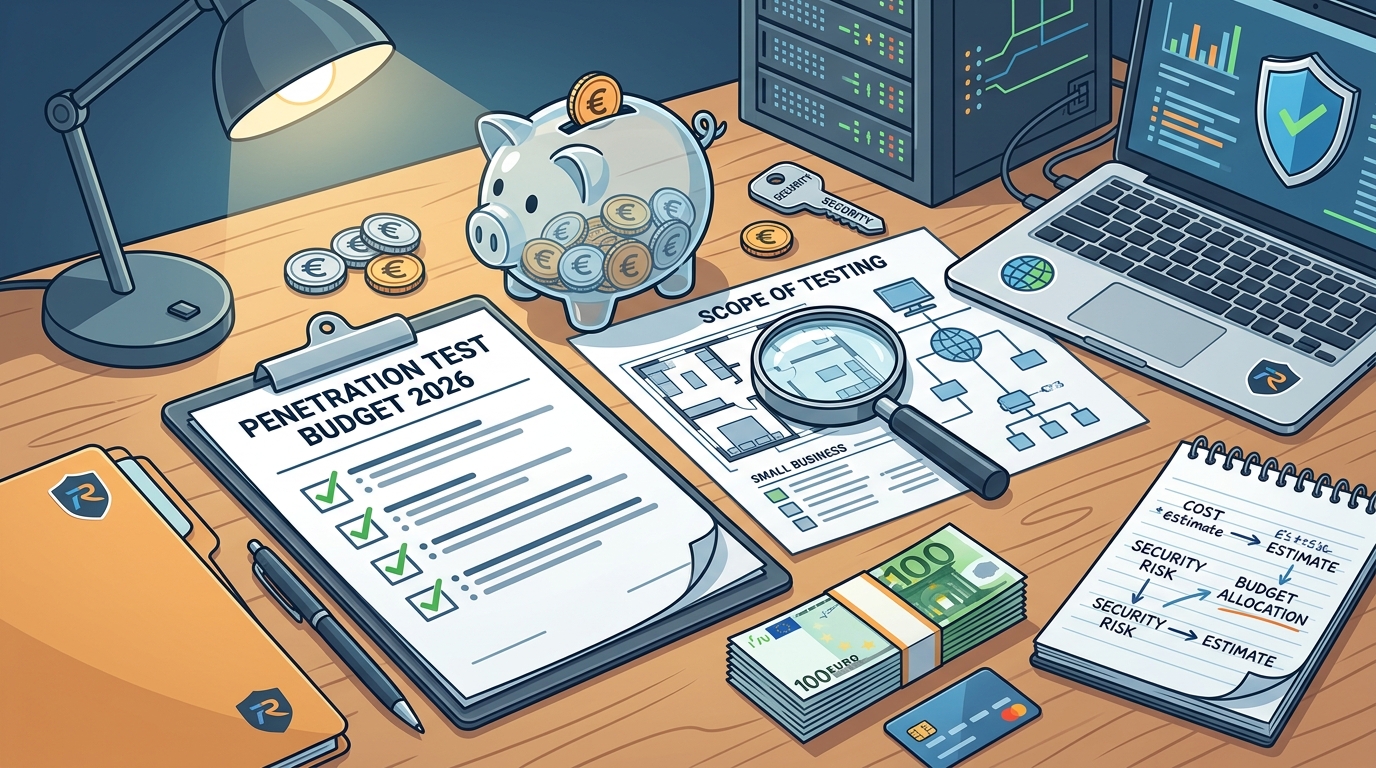
Scope is the single biggest driver of penetration test cost. It defines exactly what the tester is allowed to touch and how deep they can go. A poorly defined scope leads to either a shallow report or an unexpectedly high invoice. You must define your scope before requesting a quote to ensure accuracy.
Number of Endpoints and Assets
Each unique URL, API endpoint, or subdomain adds to the workload. A simple brochure site with five pages is significantly cheaper to test than a dynamic e-commerce platform with hundreds of product pages and a complex checkout flow. The more surface area you expose, the more time the tester needs to map and exploit it.
Authentication and User Roles
Testing requires valid credentials for different user types. If you have multiple roles, such as admin, manager, and customer, the tester must verify that each role cannot access data it should not. This increases the time required for manual verification. Providing a clear list of test accounts and their permissions helps streamline this process and keeps costs predictable.
Regulatory and Compliance Requirements
If you are subject to regulations like GDPR, PCI DSS, or NIS 2, your scope must align with specific control objectives. This often requires more detailed documentation and a deeper dive into data protection mechanisms. While this adds to the cost, it is a necessary investment for legal compliance and risk mitigation.
Testing Depth Levels
Testing depth refers to how far the tester goes beyond identifying a vulnerability to actually exploiting it. The depth of the test determines the value of the report and the confidence you can have in your security posture. There are three primary levels of depth used in the industry.
Black Box Testing
Black box testing is performed without any prior knowledge of your internal systems. The tester acts as an external attacker with no insider information. This is the most realistic simulation of a real-world attack but is also the most time-consuming. It is the standard for external assessments and is usually included in the base price.
Gray Box Testing
Gray box testing provides the tester with some internal information, such as user accounts or basic documentation. This allows the tester to focus on high-value targets and simulate an attack by a disgruntled employee or a compromised user. It offers a better balance between cost and coverage than black box testing.
White Box Testing
White box testing gives the tester full access to source code, architecture diagrams, and threat models. This is the most thorough and expensive level of testing. It is rarely used for small businesses unless the application is mission-critical. It allows for a deep code review that can find logic flaws that automated tools might miss.
| Testing Level | Information Provided | Typical Cost Impact | Best For |
|---|---|---|---|
| Black Box | None | Base Price | External Web Apps |
| Gray Box | User Accounts | +10-20% | Multi-Role Applications |
| White Box | Source Code | +50-100% | Critical Internal Tools |
Key Takeaways
- Small business penetration tests typically range from 1,500 to 5,000 EUR.
- Scope definition is the most critical factor in determining final cost.
- Black box testing is the standard for external web application security.
- Regulatory compliance may require deeper testing but is a legal necessity.
- Always request a detailed scope document before signing a contract.
- AI-assisted testing can reduce costs by automating repetitive scanning tasks.
Frequently Asked Questions
How often should a small business get a penetration test?
It is recommended to perform a penetration test at least once a year or after any major update to your application. If you handle sensitive customer data, a semi-annual test may be prudent.
What is the difference between a vulnerability scan and a penetration test?
A vulnerability scan is an automated check for known issues, while a penetration test is a manual, in-depth attempt to exploit those issues. A scan is cheaper but less thorough; a pentest provides a higher level of assurance.
Can AI reduce the cost of a penetration test?
Yes, AI-assisted tools can automate initial reconnaissance and pattern recognition, which can lower the overall cost. However, human oversight is still required for complex logic flaws and final validation.
Do I need a written authorization for a pentest?
Yes, a written authorization is legally required in most jurisdictions, including Slovenia. Without it, testing may be considered illegal. Always ensure your contract includes a clear scope and authorization clause.
What happens after the penetration test is complete?
Is a penetration test a one-time cost?
No, it is an ongoing investment in security. As your application evolves, new vulnerabilities can emerge. Regular testing ensures that your security posture remains strong over time.
Conclusion
Investing in a penetration test is one of the most effective ways to protect your small business from cyber threats. By understanding the pricing tiers, scope factors, and testing depth levels, you can make an informed decision that fits your budget and security needs. At Računalničar, we provide transparent, AI-assisted penetration testing that delivers high-value results without unnecessary bloat. We combine traditional security expertise with modern agentic workflows to ensure your systems are secure and compliant. To plan your security assessment, start your pentest brief today and receive a detailed scope proposal within one business day.